

The short answer
Most foreign buyers cannot pay a 1688 seller directly with a foreign card. The three practical routes are a bank transfer to the seller, the official cross-border service from WorldFirst (a payment company), and an agent who pays for you in RMB (Chinese yuan, also called renminbi).
Each route changes what you can recover if an order goes wrong. The rule that matters most is this: 1688 handles disputes only for orders placed and paid on its platform. Choose the route before you approve any deposit.
InterBridge, a sourcing agent in Guangzhou, can pay the seller for you in RMB. The table compares the three routes, and the sections below explain each one.
| Route | Who pays the seller | Covered by 1688's dispute service? | Records you get |
|---|---|---|---|
| Official cross-border service (World Pay) | You, through the provider, in RMB | Yes, for orders paid on 1688 | Provider and 1688 order records |
| Bank transfer to the seller | You, by transfer to the seller's account | No, the payment sits outside 1688 | Your own contract, invoice and chat records |
| InterBridge pays for you | InterBridge, in RMB | Yes through 1688 checkout; no for direct transfers | A payment record for each payment, plus quote and invoice |
Why foreign cards often fail on 1688
1688 checkout works with Alipay and Chinese payment methods. Alipay is the mobile payment app that the checkout relies on. Foreign cards are not accepted directly at checkout, so buyers outside China usually need another route.
Overseas accounts can also meet extra checks. Some buyers report login or payment checks after a change of device, network or payment method. These reports are anecdotal, so plan for possible delays.
The second barrier is the dispute route. If you pay a seller by transfer outside 1688, the platform's dispute service does not apply. Your protection then rests on the contract and the records you keep.
Option 1: the official cross-border route
WorldFirst offers a 1688 service called World Pay. In Chinese it is called 跨境宝 (kuàjìng bǎo). It lets some overseas accounts top up in a foreign currency and pay sellers in RMB.
Fees and availability vary by country, and the provider publishes its current terms. This guide does not print a fee, because the provider's own pages differ by region and change over time. Check the terms for your country before you rely on this route.
WorldFirst also warns that availability is limited for some suppliers, items, order types and checkout paths. Ask whether your supplier and product are supported before you top up. Orders paid this way are still online orders on 1688, which is the condition for its dispute service.
Option 2: a bank transfer to the seller
What you give up when you pay off the platform
A bank transfer straight to a seller's account can work, and some sellers ask for it. The money then moves outside 1688 checkout. 1688 handles disputes only for online transactions, so an off-platform transfer takes that order outside its dispute service.
You then rely on the contract, the invoice and your own records. Keep the quote, the chat where the price was agreed and the seller's invoice together, in one folder for each order.
Company account, exact legal name and a deposit
If you must pay by transfer, send money only to a company account in the exact Chinese legal name of the business you contracted with. A personal account is a warning sign. The seller's business licence (营业执照, yíngyè zhízhào) shows that legal name.
A deposit (定金, dìngjīn) has a legal limit. Under the Chinese Civil Code, a deposit cannot exceed 20% of the contract value. If the buyer breaches the contract, the buyer loses the deposit. If the seller breaches it, the seller must return twice the amount.
China-law specialists recommend a Chinese-language controlling version of any contract. Agree the price, deposit, balance, quality standard and delivery date in writing before you pay anything. Before any payment, check the company behind the store.
Option 3: an agent pays for you
An agent can place the order and pay the seller on your behalf, so you do not need a Chinese payment method. Every payment follows a supplier check and your approval of the quote.
InterBridge can pay the seller for you in RMB, at no extra charge for standard-sized orders. The exchange rate is shown in your quote. For very large orders, the payment arrangement is agreed in the quote.
Most 1688 orders that we pay for go through InterBridge's own 1688 account at checkout, so they stay inside 1688's dispute service. When a seller requires a direct transfer, we use that route instead. A direct transfer sits outside the dispute service, so the contract and the records matter more.
Either way, you receive a payment record for every payment InterBridge makes for you. You also receive the quote, the chat in which the price was agreed, and the seller's invoice when you ask for one.
InterBridge is a sourcing agent, not a bank. Payment happens only after you approve the order. For the overview, see how we buy from 1688. For typical agent fees, read 1688 agent fees explained.
When to pay the deposit and balance
Timing protects you more than the route does. Pay a deposit (定金, dìngjīn) to start production, and pay the balance (尾款, wěikuǎn) after the goods are checked.
On 1688, an order completes 10 days after dispatch if the parcel is signed for within 8 days. The seller is then paid, unless a refund is already open.
For cross-border orders, signing for the goods at the China warehouse you chose counts as your own signature. Visible damage must be raised before you sign. After signing, claims for visible defects are barred unless you have contrary evidence.
Inspect at the warehouse first: check the count, the packaging and any visible damage, and then sign.
The after-sales and dispute window is 30 days from completion. It is 28 days longer for accounts registered with a non-mainland phone number or an overseas login, for goods sent to a China transshipment warehouse, and for 跨境宝 users.
Checklist before every payment
- Confirm the payee's exact legal name against the seller's business licence.
- Check that the amount matches the quote, including the exchange rate shown in it.
- Save the quote, the chat, the invoice and the payment record in one folder.
- Pay only at the step the contract names, such as a deposit or a balance after inspection.
A first order, step by step
A first order usually follows the same sequence, whichever route you use. The steps below assume that an agent pays for you.
- Send the 1688 link or product details, with the quantity, destination and target date.
- Review the quote, including the price and the exchange rate.
- Approve the order, and pay the deposit at the step the contract names.
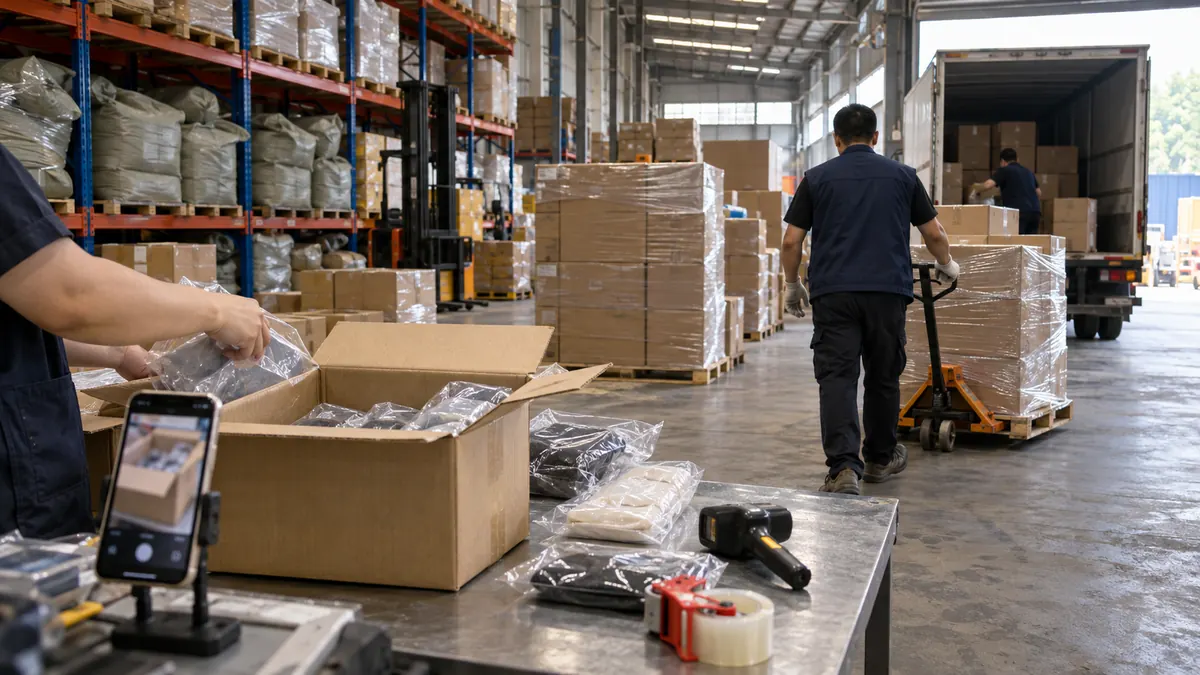
- Goods arrive at our own Guangzhou warehouse, where they are counted and checked for visible damage.
- Pay the balance after that check. Export shipping is arranged and quoted separately.
Keep the quote and every payment record from step two onward. Together they show what you agreed and what you paid.
Payment mistakes to avoid
These habits cause avoidable payment problems. Check each one before you send money.
- Bank details that change in chat. Confirm any new account on a second channel before you pay.
- A personal account, or a stranger's QR code. Pay only the company named in the contract.
- Moving the conversation off 1688. Keep prices and promises in Wangwang (旺旺, wàngwàng), 1688's chat.
- Paying in full on a first order. Pay a deposit first, and the balance after checking the goods.
If a payment goes wrong
Time limits on 1688 run from dispatch and completion, so act quickly if something is wrong.
Stop further payments until the problem is clear, and ask the seller for a written statement of what went wrong. If the order is on 1688 and the goods are wrong, open a refund before the order auto-completes, because completion releases the payment to the seller.
If you paid by direct transfer, the 1688 dispute route is not available. Your contract, invoice and records then carry the case, so keep them complete. For disputes that need action in China, see Trade Dispute Support.
Sources
- 1688 transaction dispute rules, rule 945 (1688 platform rules, revised 2025-06-27; in Chinese): rulechannel.1688.com
- 1688 automatic completion rule, rule 20003242 (1688 platform rules, revised 2025-10-11; in Chinese): rulechannel.1688.com
- 1688 cross-border dispute rules, rule 20005656 (1688 platform rules, revised 2026-01-20; in Chinese): rulechannel.1688.com
- 1688 after-sales time limits, rule 20006859 (1688 platform rules, revised 2026-09-09; in Chinese): rulechannel.1688.com
- How to buy from 1688 (WorldFirst UK, updated 2026-08-03): www.worldfirst.com
- 1688 and World Pay (WorldFirst help centre, undated): www.worldfirst.com
- How to pay 1688 without Alipay (WorldFirst Malaysia, 2026-07-15): www.worldfirst.com
- Alipay transaction limits for overseas visitors (TechNode Global, 2024-03-08): technode.global
- Civil Code, Articles 586 to 587 on deposits (in Chinese; text as published by People's Daily): cpc.people.com.cn
- Contract language in China (Harris Sliwoski, China law blog, undated): harris-sliwoski.com
Questions answered in this article
Can I pay on 1688 with a credit card?
Foreign cards are usually not accepted directly at 1688 checkout. Some cross-border routes accept cards, with fees that vary by provider. Alipay's limit for visitors with foreign cards, US$5,000 per transaction, is set for travel, so it does not suit wholesale orders.
Why was my 1688 payment or account blocked?
Overseas 1688 accounts are commonly reported to meet risk checks after a change of device, IP address or payment method. Complete the verification when 1688 asks for it, or ask your agent to place and pay the order. Keep your own record of every payment you make.
Is it safe to pay a 1688 supplier by bank transfer?
A bank transfer can work, but it takes the payment outside 1688's dispute service, which covers only online transactions. Pay only a company account in the exact legal name of the business you contracted with, and get the terms and an invoice in writing before you pay.
What records should I get when an agent pays for me?
You should receive a payment record for each payment, the seller's invoice, the exchange rate shown in your quote, and the chat where the price was agreed. InterBridge shares these records for every payment it makes for you. Keep them with your contract in case of a later dispute.
Ask a question about this article
Questions are checked for relevance and spam. Your email is used only if a reply is needed.
Questions and comments
No public comments yet. You can ask the first question below.